


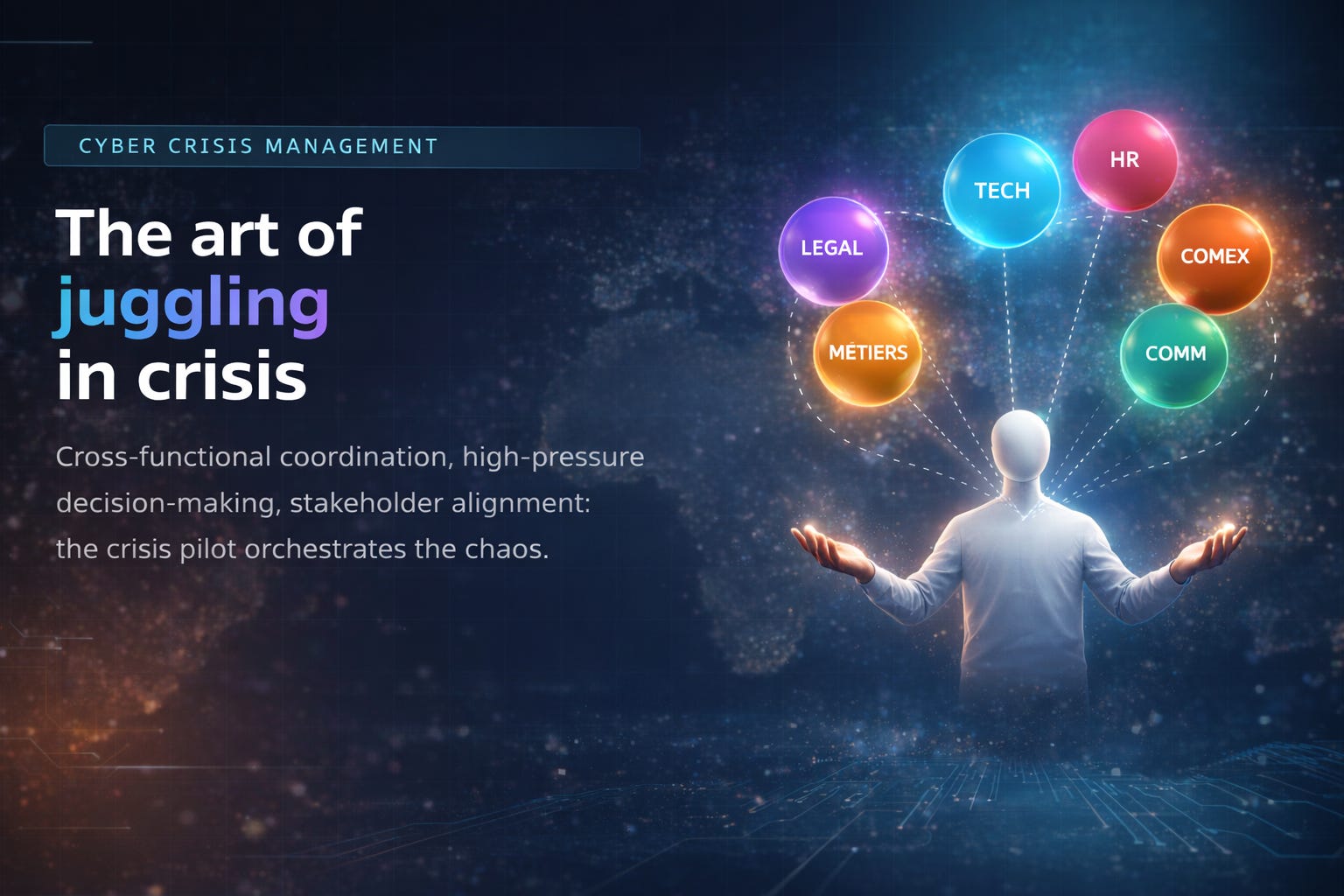
“What exactly do you DO here?” a CISO asked me 48 hours into a crisis
Fair question. I’d been in every meeting, written half the comms, coordinated with external teams, and somehow still hadn’t ‘fixed’ anything within his area of responsibility.
After managing dozens of crises since 2019, I’ve learned the crisis lead role is invisible when it works—and catastrophic when it doesn’t.
But, then again, what exactly do I do here?
Here’s what that role actually entails, depending on the victim organization’s maturity in crisis-management capabilities.
Coordination and governance
Ensure cross-functional coordination between all stakeholders (CIO, CISO, business units, executive management, external service providers)
Ensure the proper functioning of crisis cells (decision-making and technical)
Verify that crisis cells are effectively staffed and operational, and raise alerts in case of failure
Define (if not already in place) and enforce the cadence of crisis meetings (frequency, duration, attendees)
Maintain alignment between the decision-making cell and the technical cell throughout the crisis
Advisory role and interface with executive management
Provide executives with the information required to make informed decisions
Clarify technical, legal, and communication-related risks
Help translate technical issues into business language for the executive committee
Advise management on strategic trade-offs (restart priorities, resource allocation)
Frame discussions around a potential ransom payment (in ransomware incidents) using factual, objective elements
Contribute to drafting (or, in many cases, directly writing) internal and external communications
Operational sequencing and steering
Contribute, when requested, to defining the sequencing of actions based on how the situation evolves
Ensure consistency between isolation and remediation actions
Validate prerequisites for a phased restart of information systems (initial compromise date, available indicators)
Track the progress of incident response and forensic investigation teams
Coordinate the transition from emergency response to reconstruction
Documentation and traceability
Ensure proper logging and incident diaries are maintained within each crisis cell
Advise teams on traceability of checks performed on systems prior to restart
Coordination with external parties
Coordinate interactions with external incident response teams (CERT/CSIRT)
Organize technical communications with interconnected customers and partners
Support the industrialization of reassurance processes toward third parties (technical commitments, evidence of controls)
Facilitate interactions with authorities when required (national cybersecurity agencies, law enforcement)
Remediation and security advisory
Advise, when appropriate, on the deployment of emergency cybersecurity solutions (EDR, monitoring)
Validate conditions for the progressive reopening of Internet access
Ensure hardening measures are integrated into the reconstruction plan
Support the definition of criteria for pre-restart control checkpoints
Human and logistical management
Alert management to the risk of burnout among key personnel
Monitor team cohesion and morale throughout the crisis and raise alerts if degradation could jeopardize crisis operations
Preparing for crisis exit
Define objective exit criteria with the decision-making cell
Prepare the handover to internal teams for the return to normal operations
Contribute to organizing the post-incident review
Identify security initiatives to be launched after the crisis
Of course, every crisis and every organization is different, so the balance across these areas can vary. Some internal functions may fully take over certain tasks from the crisis lead—but he or she must still maintain visibility over them, either to contribute directly or to enrich collective decision-making.
Today, this role is better understood, yet remains just as difficult to staff (internally and externally). It is often split across several profiles, particularly within organizations. But this inevitably increases the coordination burden—which is then frequently outsourced.
After another crisis ended, a CTO confessed: “I wasn’t convinced we needed you. But I get it now. You were the glue.”
That’s the crisis lead role: the glue nobody sees until everything falls apart without it.